Misunderstood Modernity_

Heading towards the end of lockdown 2 in Paris, art lovers are looking forward to return to the fabulous collections and exhibitions the city can offer. The Musée d’Orsay houses the national art collections spanning from the mid-19th C to World War I, and it has been a very pleasant surprise to discover 60 original drawings by the English artist who shook and shocked Victorian conventions defining modernity in graphic arts.
Aubrey Beardsley, born in 1872, started drawing early, as a past-time during a tuberculosis crisis. After he finished school, he was hired as an office clerk but kept illustrating his favourite reads, until he considered his day job too boring and put all his energy into his art, at the age of 20. By the time of his death, only 6 years later in 1898, he had accomplished a very modern and inventive corpus of drawings that served all kinds of publications and influenced the Aesthetic Movement and Art Nouveau. By using just a pen and ink, he created powerful, multidimensional images in a perfect balance of black and white, and launched the idea of beautiful books and editions as a total work of art. He also left behind scandals and legends that made him the epitome of the doomed artist. The list is long indeed, of talented makers that make us wonder what could have they accomplished if they had more time?
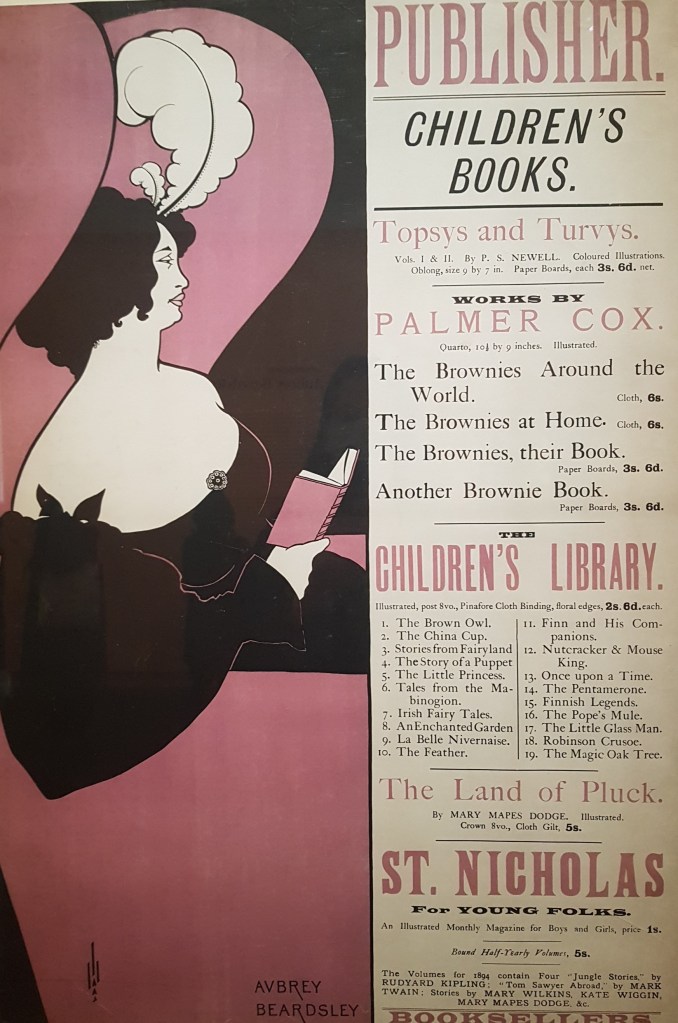
All his career has been associated to publishing houses, illustrating books with various degrees of controversy. In the poster above advertising children’s books, the image is beautiful but quite inappropriate for its objective. A pattern and a style are already established, creating ambiguous and sensual pictures, out of any familiar context. Nevertheless, this is how very early on, his personal vocabulary took shape and his reputation became only more notorious.
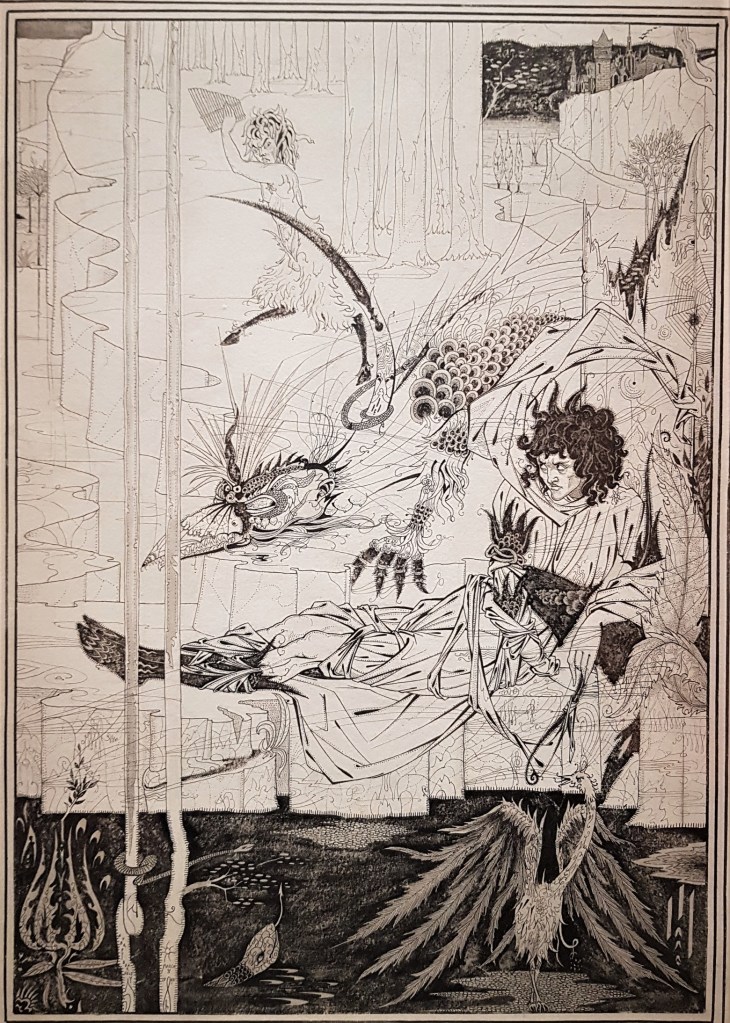
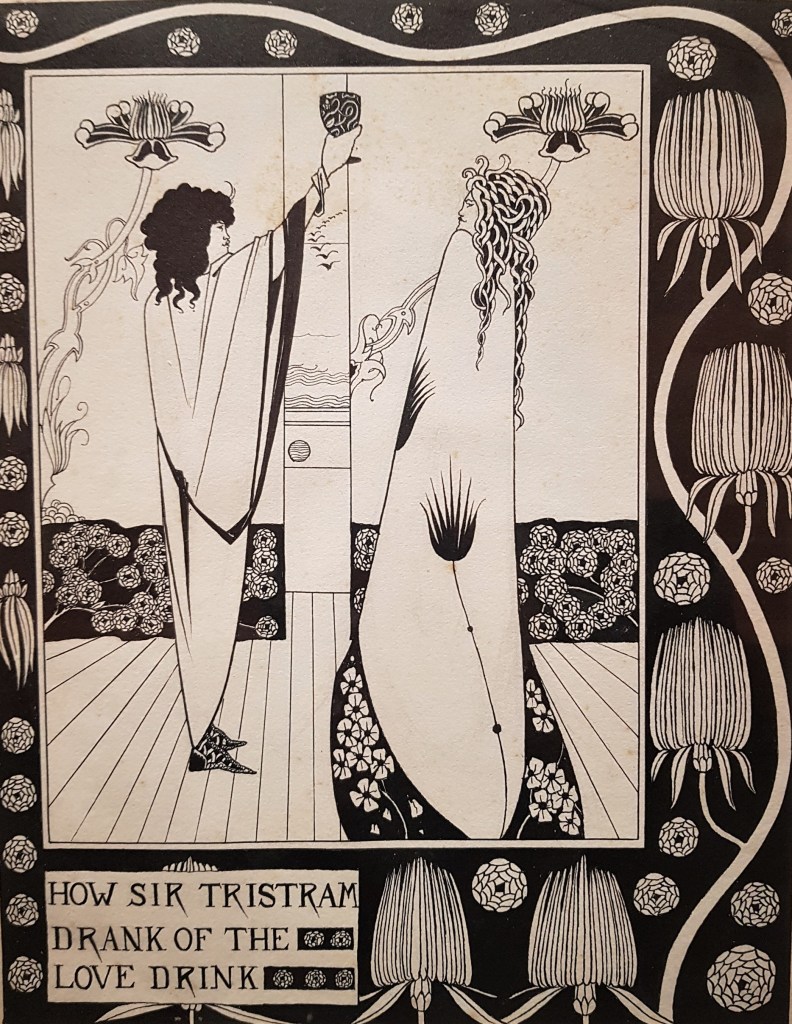
His first major commission was the illustrations for the Death of Arthur, a medieval text, that offered 3 times his salary and thus he was able to quit his day job. This project occupied him for 2 years producing over 350 drawings, unfolding his influences and their very modern interpretations. Profiles are Pre-Raphaelite, compositions and formats are borrowed from Japanese woodblock prints, exotic animals are drawn from the Chinoiseries, borders remind us of the Japanese katagamis (stencils), expressions are created by a contrast of black and white as admired in the Greek Pottery of the British Museum, the ‘hairline’ style is borrowed from Art Nouveau. All of the above is invaded by decorative motifs providing cohesion among the often unrelated episodes, figures or contexts. Lines exist in a decorative profusion, renderings are extremely varied, details are strange. Actually, the more we look, the more we see. He introduced endless possibilities to the illustration of books, making it a parallel art to literature, launching this way the 20th C graphic creation.
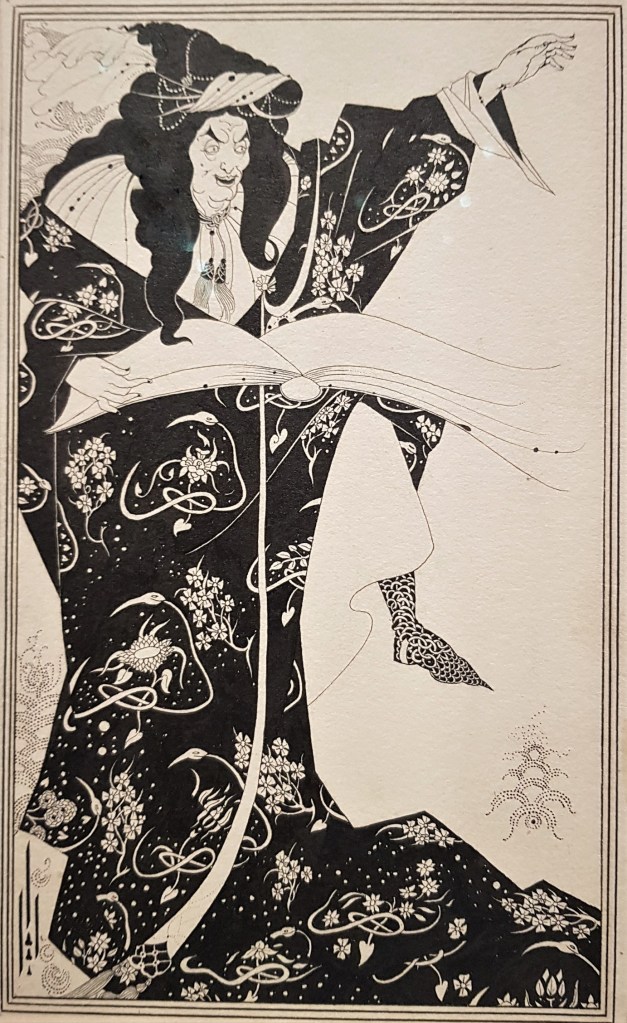
The Art Institute of Chicago
In Virgilius the Sorcerer, the Japanese influence is obvious, but its ambiguity is even more striking. The construction of the image is not any more founded on the sacred idea of perspective inherited from the Renaissance but on the two-dimensional rendering discovered in Japanese prints. Moreover, the medieval figure is dressed in a lavishly embroidered kimono and strikes a pose reminiscent of the Kabuki actors, whose portraits were collected by passionate art lovers in Europe. Complex motifs represent a precious aspect and provide an astonishing field of depth in this otherwise flat image.
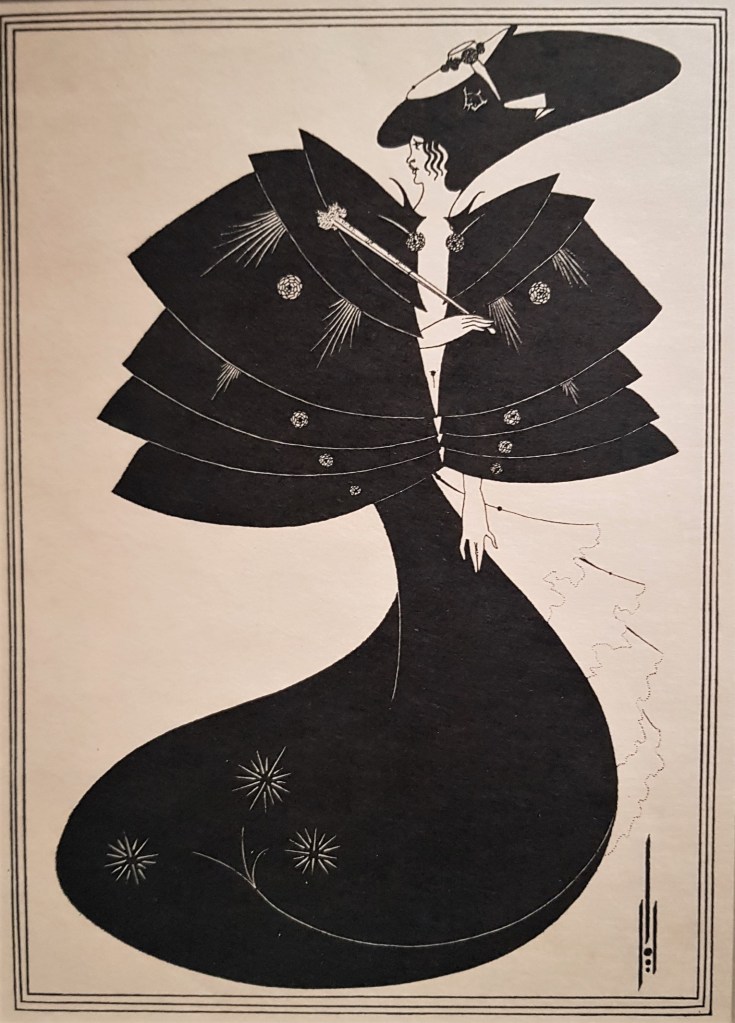
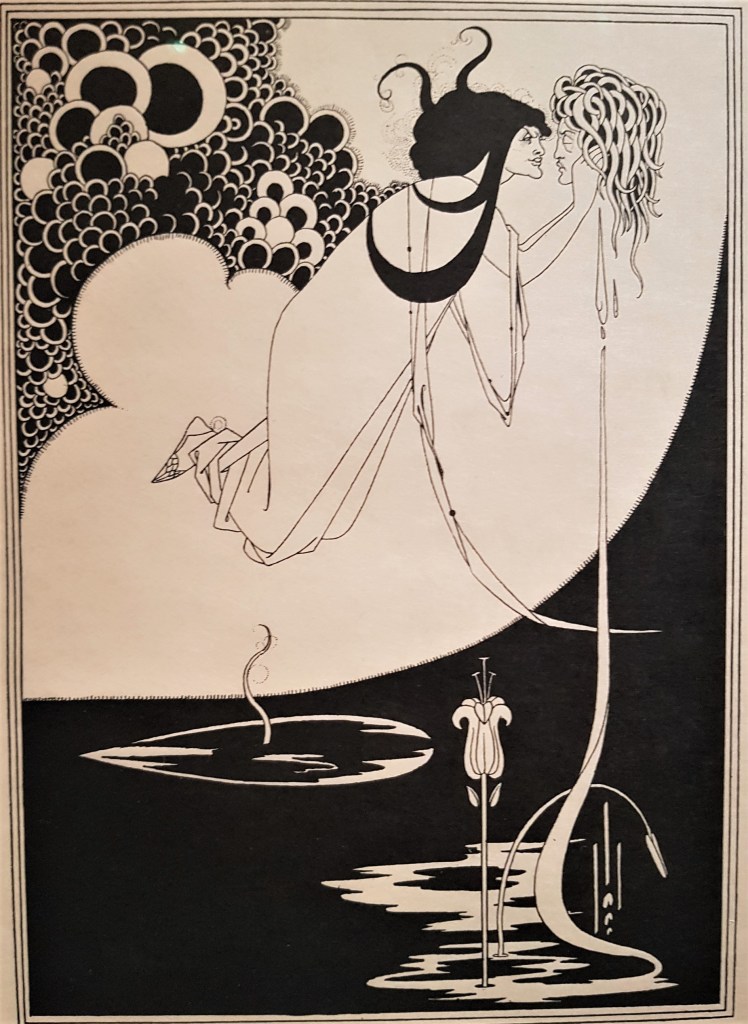
In 1893, Beardsley’s path crossed that of Oscar Wilde. Wilde had just written Salome in French, and was looking for an illustrator for its first English edition. The play had already caused a scandal as it was depicting Biblical figures on stage and featured Herod’s incestuous lust. Salome would sum up the art and style of Beardsley: all erotic aspects considered in an explosive mixture of legends and references from the past in a personal, contemporary context of intense eroticism, passion, desire and death, linking him forever to the Decadent movement and all its negative connotations in the Victorian era.
Most of his drawings for Salome were considered too explicit and had to be modified. Wilde did not mind, as he appreciated the controversy that would trigger more interest in his work. The Black Cape is anachronistic but of a remarkable modeling, depth and movement, mostly associated to the extreme geometry of the armour of a Samurai, than to a Biblical figure. Its absurdity was tremendously provocative, along with the gestures that are often suggestive in Beardsley’s drawings. The Peacock Skirt, featured in the beginning, is a manifesto to the very popular motif of peacocks at the end of the 19th C. and plays the role of intensifying our gaze to the action via the multitude of flowing lines, very much in the Art Nouveau spirit. Finally, the Climax, featuring Salome holding St John’s head, as a trophy and in horror at the same time, is one of his most famous drawings, deeply expressive and sensational.
However, the publication backfired because the public found the images irrelevant, indecent, even blasphemous, but also overshadowing Wilde’s writing, something that the writer had not anticipated. Beardsley was regarded as rather an attention-seeking dandy than an obedient draughtsman, and he would pay soon the consequences of being associated to Wilde.
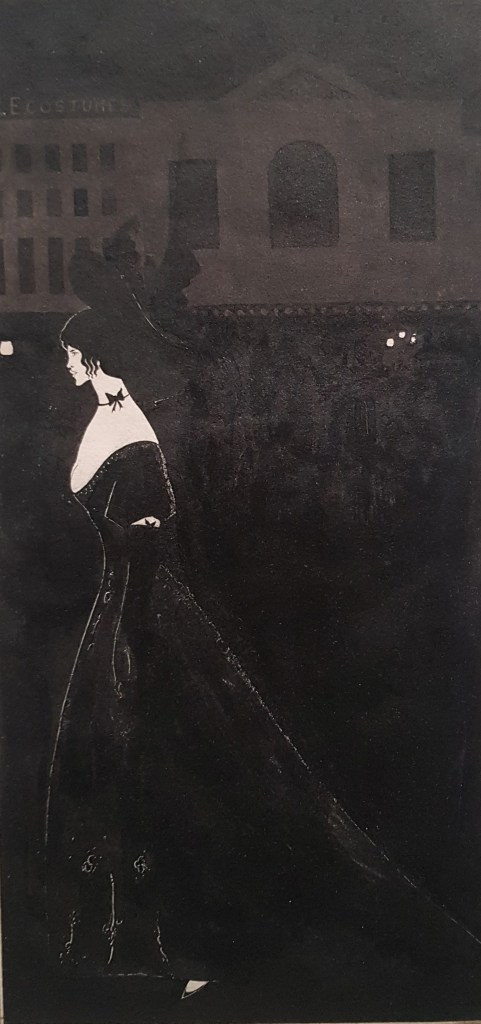
Beardsley’s style was provocative to society, conventions, etiquette and tradition but he also challenged the rules and aesthetics of his proper art. Advised against using too much black in his illustrations, he did just the opposite. His black manner, or manière noire is a drawing technique where black occupies a much greater area than the white, as skillfully demonstrated in the Night Piece above.

He was on the peak of his fame, notoriety and craft when appointed art editor of The Yellow Book, a groundbreaking magazine on art and literature, published with a hard cover and a provocative title referring to the yellow wrapping paper used for French erotic literature. The first cover perfectly set the tone, featuring an independent, laughing woman, perhaps making fun of us, and a second figure slightly in the background looking thoughtful enough to provoke our reflections. His radical style, known as “night piece” or “manière noire” matured, with very large black areas and sharp white lines in reserve. Toulouse-Lautrec’s influence is obvious, but the context is clearly the London night scene with its gas street-lamps. The press was extremely negative to this new publication as it appeared too modern, too dangerous, too decadent. Beardsley had edited only 4 issues when dismissed in early 1895 after Wilde was prosecuted for committing indecent acts. The downfall was brutal for the whole Decadent movement and Beardsley had to self-exile to France. Commissions lost their prestige and his income remained unreliable until his death, 3 years later.

Nevertheless, he continued drawing and producing illustrations for more obscure publishing houses on the limit of pornography. This allowed him to further explore his art and relentlessly develop new graphic styles. Often he would interpret in a subjective manner, the artistic and historical context of the book. In the case of The Battle of the Beaux and the Belles, his source of inspiration was the 18th C. French copperplate prints and consequently he developed a technique described as ’embroidering’ or ‘filigree’, reflecting the refined and overcharged language of the original text.
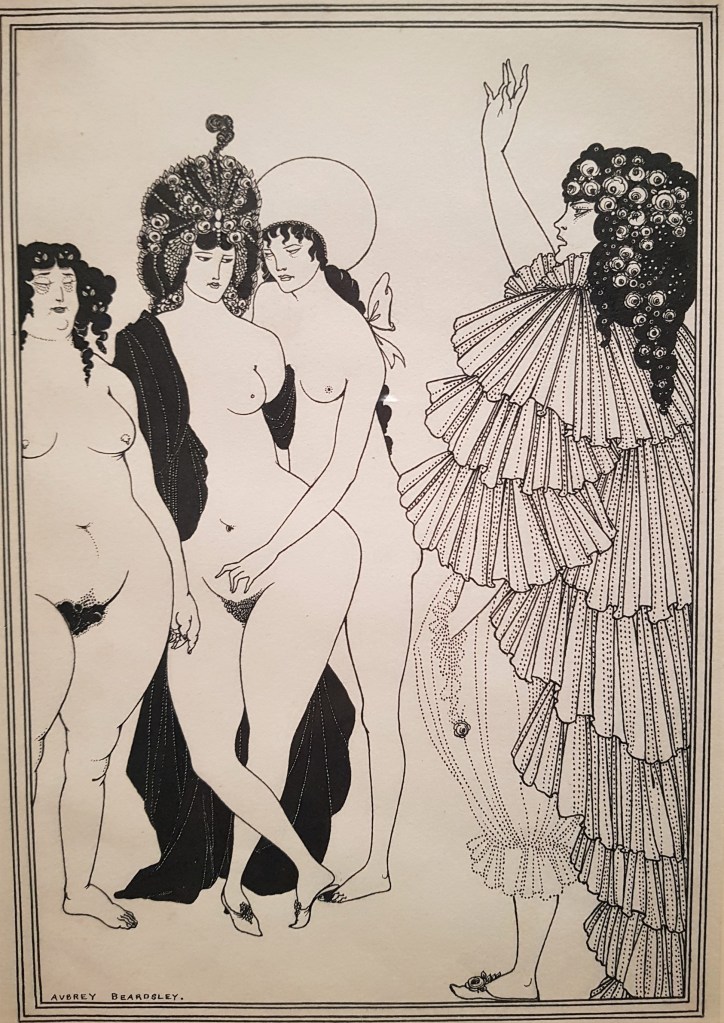
In France, he worked on his most sexually explicit drawings, that could not be published and which circulated privately among high society members. Eight of them illustrated Aristophanes’ Lysistrata, developing a different, more linear style in compositions once again attuned to the context of the book, reminding of Greek vases but also of Japanese erotic prints. Lysistrata was published in only 100 copies; a wide-public edition was possible only in 1966. Beardsley was interested in all kinds of sexuality, depicted with the right amount of sophistication and humour, that made his drawings desirable not only by voyeurs but also by connoisseurs.
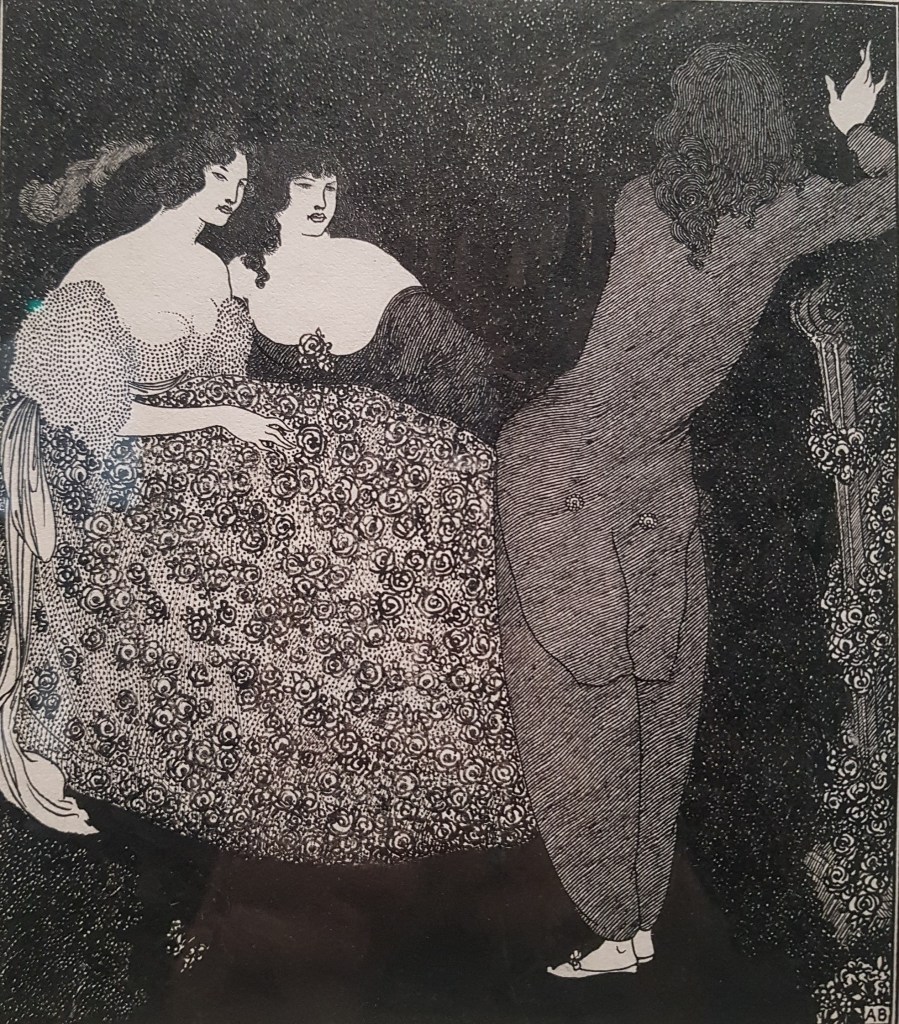
Most of his last projects remained unfinished, he knew that time was short and worked in a frenzy. He kept developing new techniques, revisiting styles and creating all the more modern designs. One of his uncompleted endeavors was the illustration for Tristan and Isolde where different renderings create a rich, mesmerizing surface. As the end was near, he converted to Catholicism and asked his editor to destroy his most compromising drawings. Thankfully, he did not. Aubrey Beardsley died prematurely from consumption at the age of 26 in the French Riviera.
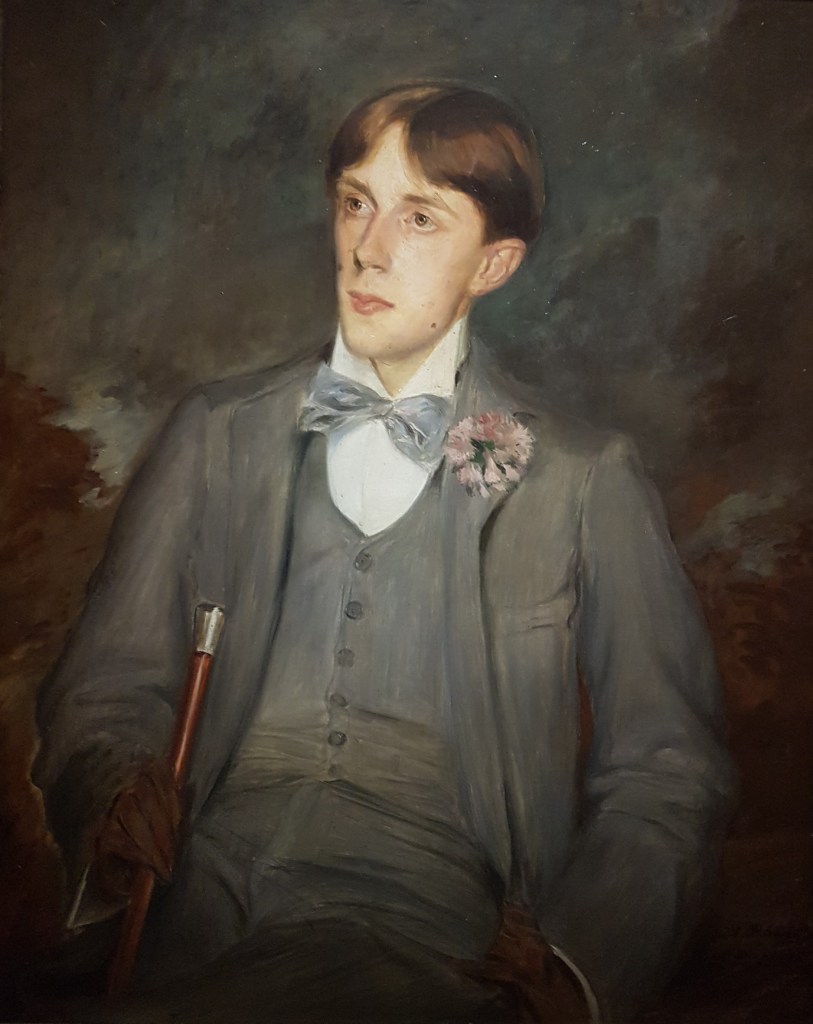
His impact was such that W. B. Yeats suggested that the last decade of the 19th C. can be summed up by Beardsley’s 6-year career, and indeed today, the 1890s are also known as the Beardsley Years. Picasso, a young, aspiring artist in Barcelona, read an obituary and was so impressed that he made a drawing in Beardsley’s style. His one of a kind personality, his culture, his humour, his inventiveness and his quest for beauty made him a much admired and respected artist from the 1960s onwards and still today his art is a reference for graphic designers.
Aubrey Beardsley, Musée d’Orsay, until January 10th, 2021.
All photos ©TheChoiceOfParis
 The Choice of Paris