The painter who declined the invitation of the Impressionists

The Orsay Museum houses the richest Impressionism collection in the world, and most visitors access directly the 5th floor to enjoy the best of this art. The museum collections cover however the entire period of French Art from the 1850s to the First World War, and the various styles that have come and gone from fashion. James Tissot rejected the invitation by Degas in 1874 to participate to the first exhibition of the Impressionists (as they would be later known). Thus, it is interesting to keep in mind when visiting this retrospective exhibition, that Tissot wasn’t deliberately part of one of the most famous artistic groups ever; he existed and progressed in a parallel way, having his personal share in the modernity launched.
The viewer is immediately taken aback by the richness and the fine details of fabrics and fashion. Born in in the seaport of Nantes, his family run a drapery and clothing shop that explains his painting style. Without diving deeper to his art, anyone can enjoy the fashion, skillfully depicted, in his paintings.

In one of his early works, the Portrait of the Marquis and Marchioness of Miramon and their children, the details are striking and yet it is not just a very accurate image of fabrics and objects. The composition is thoroughly studied, the boy is impatient and absent minded, the characters can be read. The scene takes place in an autumnal setting, somewhere in the countryside, reminding the portraits of the English aristocracy and breaking thus with the conventions of the time in France.
After the Franco-Prussian war and the Paris Commune, that he witnessed and drew first-hand, Tissot moved to London where he stayed for 11 years. He had already anglicized his first name from Jacques to James. Obviously, for someone understanding and appreciating fashion, he was a dandy, and a Parisian in London while an Englishman in Paris; this duality is featured in his works.

In London, he drew caricatures for the Vanity Fair and this way he was introduced to the high society. The Frenchman in England undertook many prestigious commissions, but his distanced point of view made critics sometimes accuse him of mockery and irony. Ambiguity is typical of his production; we think we understand what is happening, but we have some doubts. The subject-matter becomes an elegant caricature on his canvas. Moralizing paintings were a trend, and yet the moral is obvious and missing at the same time. In this aspect lies his modernity. The viewer is invited to make up his own story and judgement.
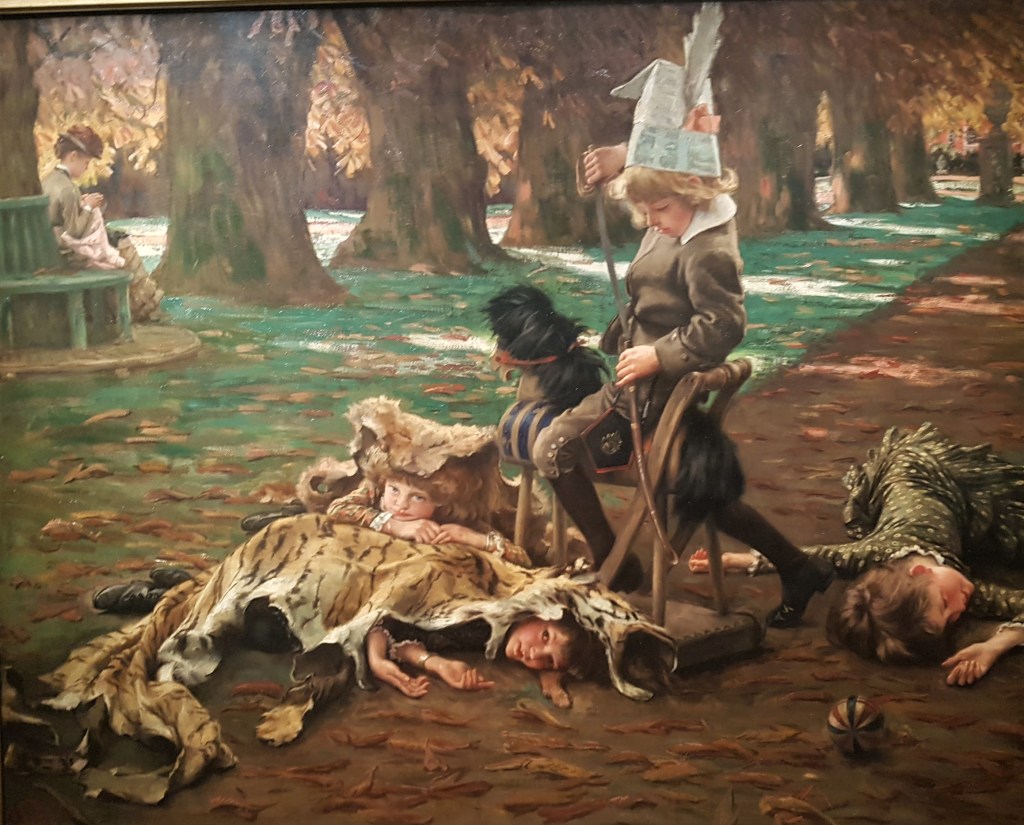
The Nemrod is a title drawn from the Bible referring to a fearless character, but the painting has not any Biblical claims. A fearless boy is chasing the other children dressed up as wild animals, two of them are gazing at us cheekily, the governess is oblivious in the background.

Gazes often provide the clue to the interpretation that Tissot challenges on us. In Too Early, after the initial impression of utter elegance, we notice the two servants peering out of the door. Contrary to the high society and the Victorian etiquette, these two figures are excused to express the awkwardness of the moment: the guests arrived too early for a party and they feel uncomfortable, the hostess is still giving instructions to the musicians, the empty space looks even emptier.
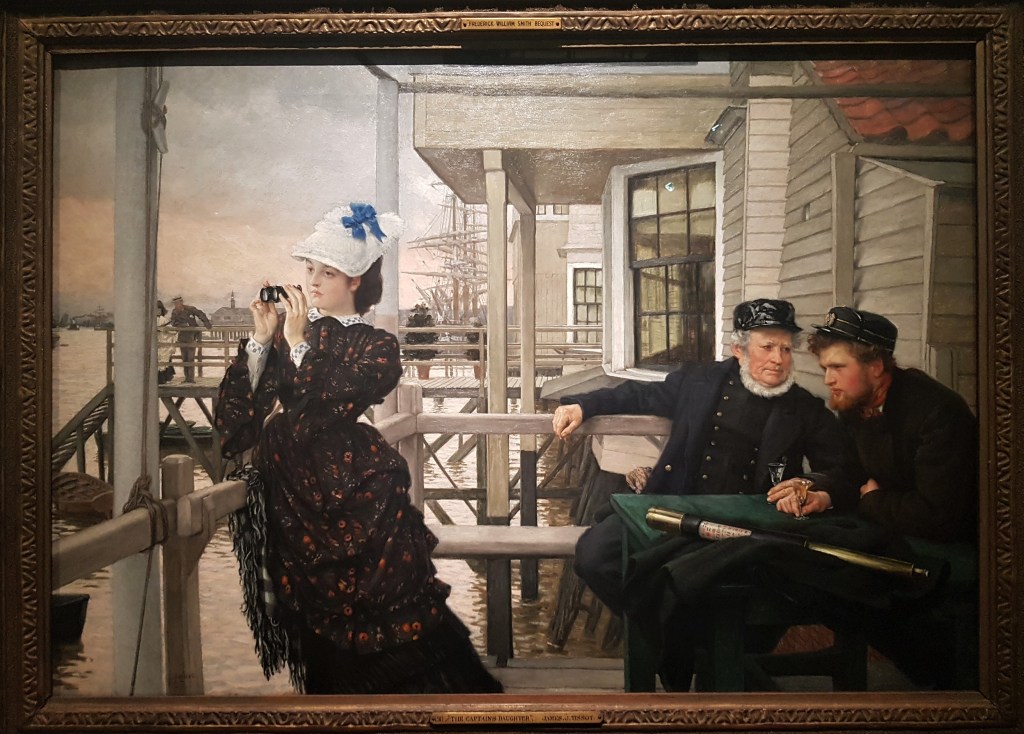
The Captain’s daughter is equally about an awkward moment. Two sailors are intensely looking at a young lady. She could not look any further, holding the binoculars, clearly not interested. Tissot, coming from the port-town of Nantes and being an expert in fabrics, adds another clue. The blue pattern on her cuffs and collar corresponds to the maritime code signal for NO. The maritime code is featured on the telescope in front of the 2 sailors, and sill, they don’t get it. Tissot’s view is sarcastic and entirely shakes up the Victorian sentimentality, with a sense of humour still entertaining today.
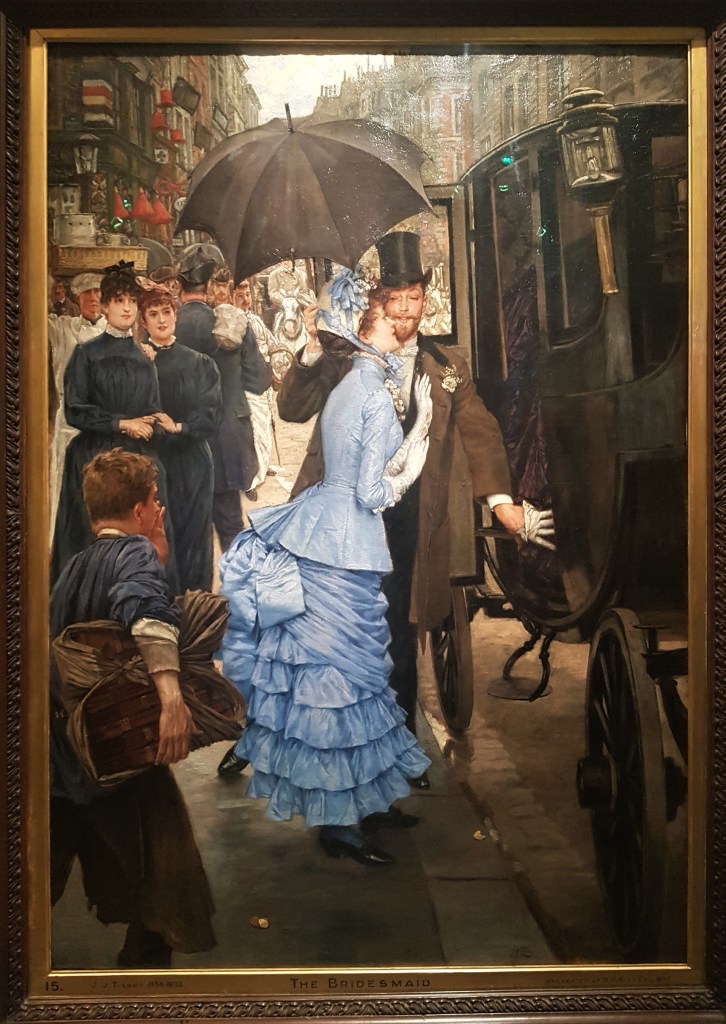
Gazes are also the leading theme in The Bridesmaid, a painting in a series about French Women living in the most modern city in the world back then, Paris. The bridesmaid, dressed in a striking blue dress, is shamelessly flirting with the groom while the passers-by are watching. In case the spectator missed the point of this painting, a clue reminds him: the red sign of an optician on the left of the picture. Every figure looks in a different way, revealing a different character. The groom is staring back to us and we become partners in crime. The modernity of Tissot concerns also the invitation to the viewer to participate to the action, as the Impressionists were also exploring at the time.
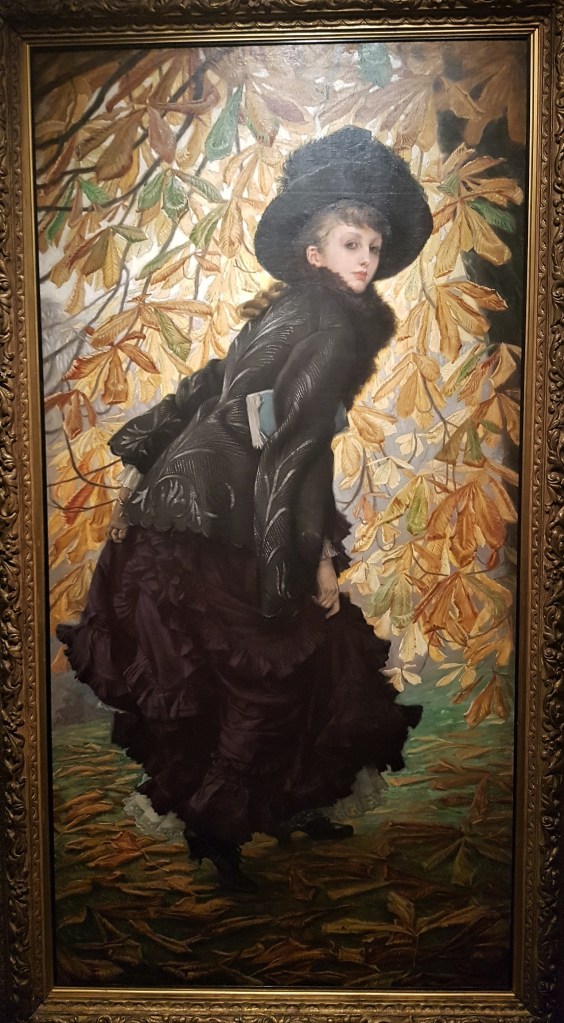
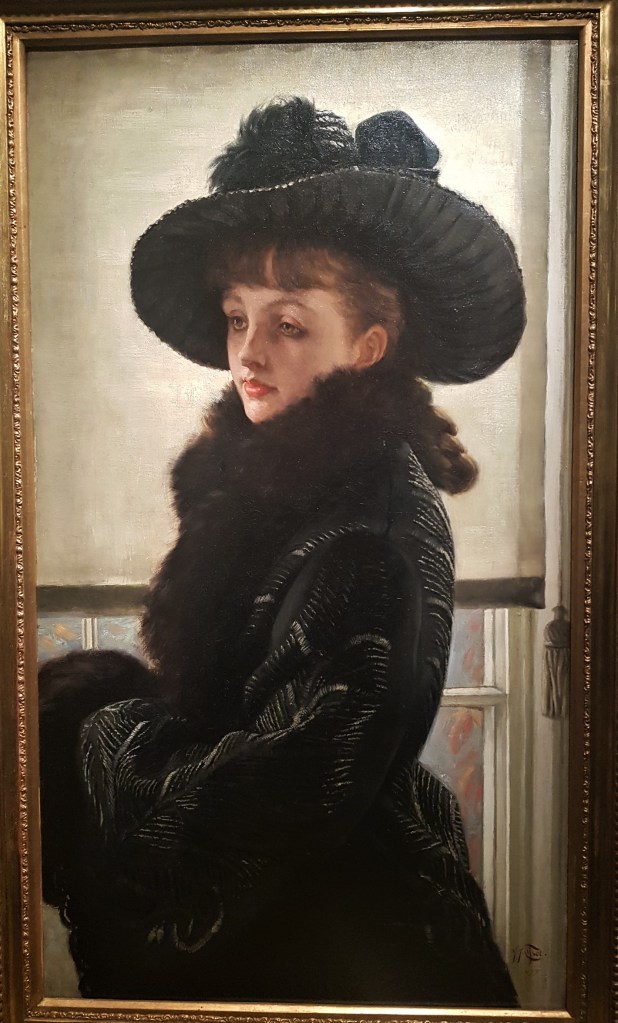
A very important chapter in his life and his career was Kathleen Newton. An unconventional woman, divorcee and adulterous, mother of two children, she represented the absolute opposite to the Victorian morals. She was the great love of Tissot, who progressively abandoned social life for domestic bliss. Kathleen became his muse, as numerous portraits and larger compositions illustrate. October is a painting revealing her powerful appeal, in stark contrast to the dry leaves that enhance her beauty and provide the golden backdrop of an Italian Madonna. Mavourneen, darling in Irish Gaelic, is another portrait of Kathleen, immaculately dressed and psychologically observed in the usual Tissot manner.
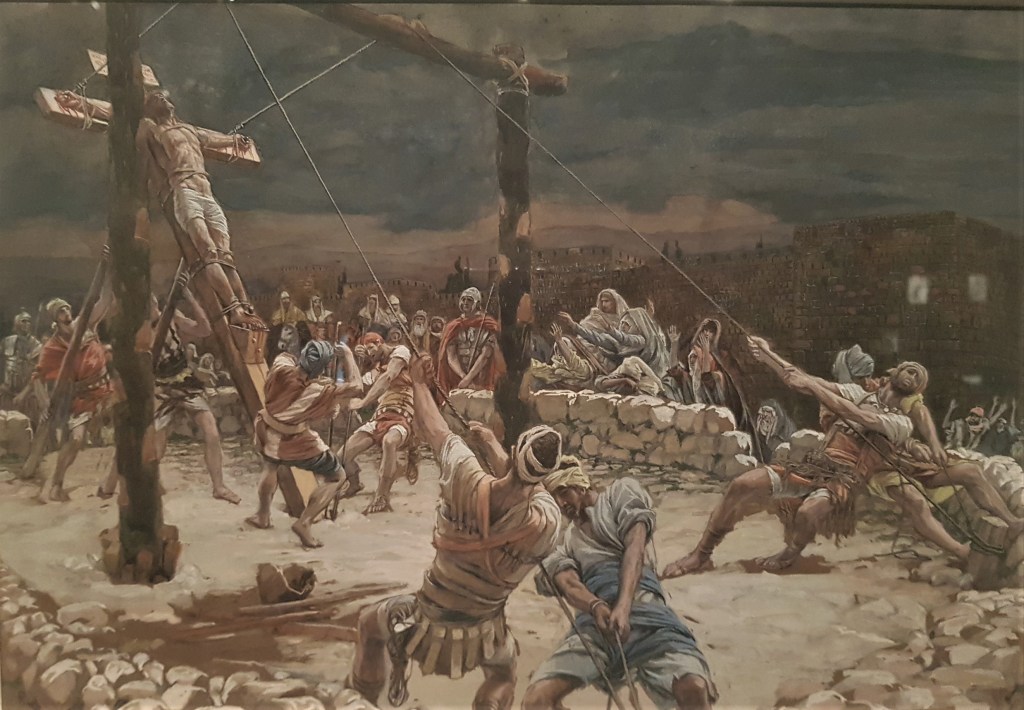
Kathleen died too young in 1882. Tissot, devastated, returned to Paris haunted by her death. He found refuge in spiritualism and esoterism, while undertaking religious subject-matters in his art. The exhibition explores this period with a series of drawings and publications that demonstrate once again his observing eye for large compositions full of details.
James Tissot was an ambiguous figure in ambiguous times, moving between the Victorian England and the Post-War France. A man of his times, he processed all the different stimuli and produced a unique, unclassified style perfectly unfolded in this exhibition.
James Tissot: Ambiguously Modern, Musée d’Orsay, until September 13, 2020
All Images (c) TheChoiceOfParis
 The Choice of Paris