Light travels from the past
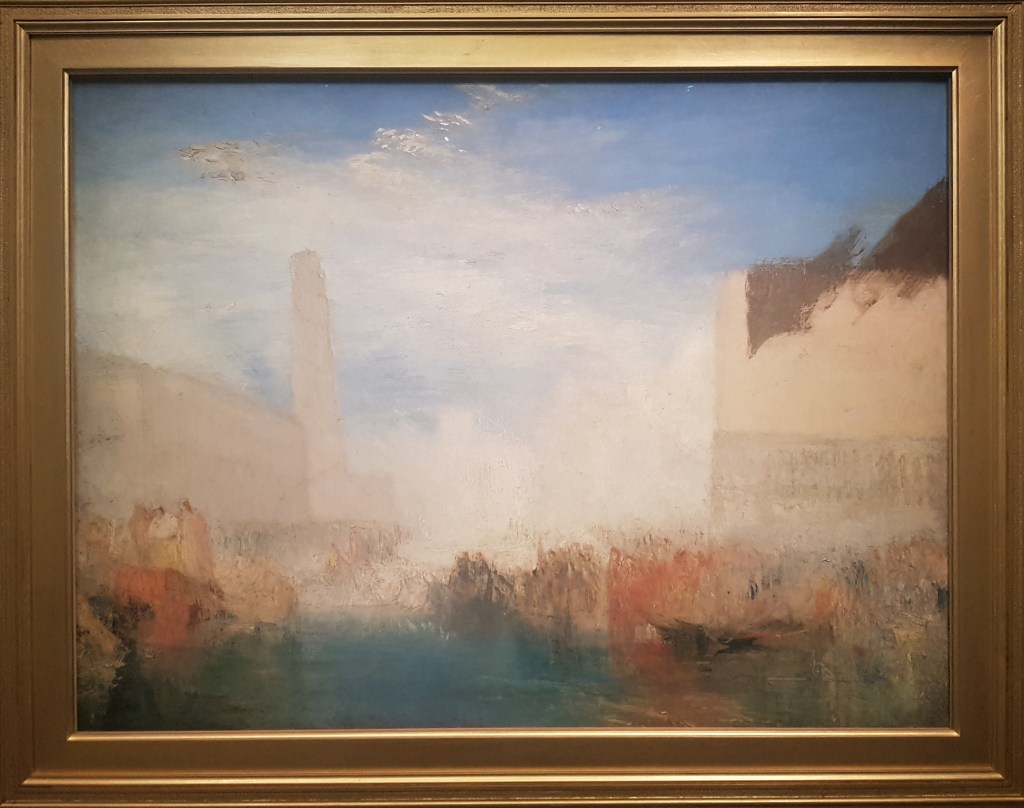
William Turner, one of the most celebrated British artists, bequeathed to his country the content of his workshop: 300 paintings, 3000 watercolors, 20 000 drawings and sketches, 32 000 pieces in total. His heritage is kept in Tate Britain and is still being studied, revealing his genius and his secrets. The exhibition at the Jacquemart-André Museum, in Paris, explores the evolution of his art of watercolour from topographical drawings to the representation of light, in all its forms, possible before only by oil colours.
The artworks on display are rather typical of his private practice and experiments, while some oil paintings provide the necessary comparison of the techniques and the illustration of his achievements in both media. The layout of the exhibition is chronological with an emphasis on the evolution of his watercolour technique. However, for those not familiar with the materials, I suggest looking at the 60 drawings and 10 paintings on display, in a different way: through locations. Turner had travelled a lot more than the average Englishman back then, 21 times in Europe, sketching in situ, studying and experimenting with the light.
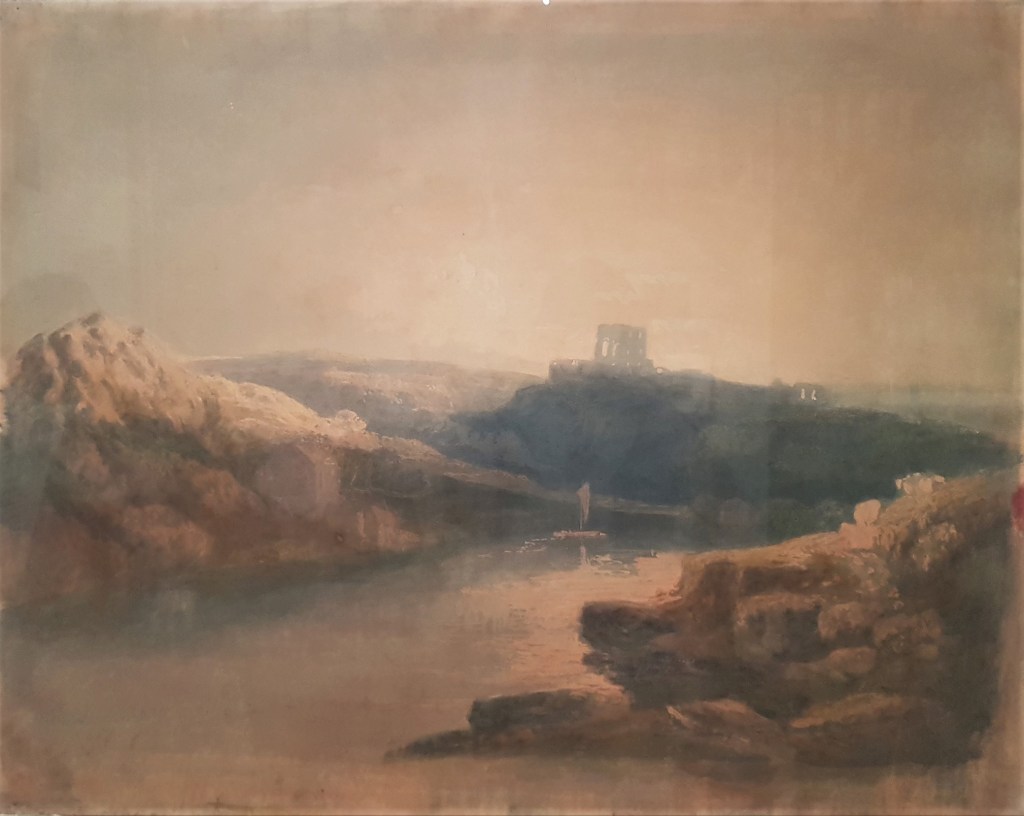
As a young artist and member of the Royal Academy, Turner would seek inspiration and answers to his research by visiting first his homeland, all the way to the Scottish Highlands, where he depicted numerous times Norham Castle. The subtitle a colour study reveals his objective: to seek the effects of light dispersed from the background. He achieves that by applying a warm-colored preparatory layer resulting into a luminous landscape with the contour of the castle reminding the scale of the composition. The addition of a manmade element, an architecture, a boat, a lighthouse or other, is found in most of his works and makes the ensemble find its meaning while adding an historical dimension.

The Caernarvon castle in Wales, inspired him a watercolour presented in the annual exhibition of the Royal Academy, elevating the art of watercolor to a technique equal to the intensity of oil painting, in spectacular, colourful and luminous compositions. Watercolour is used in this ambitious composition for its clarity and lightness, but also as a demonstration of his skill in a technique that requires speed and certainty.
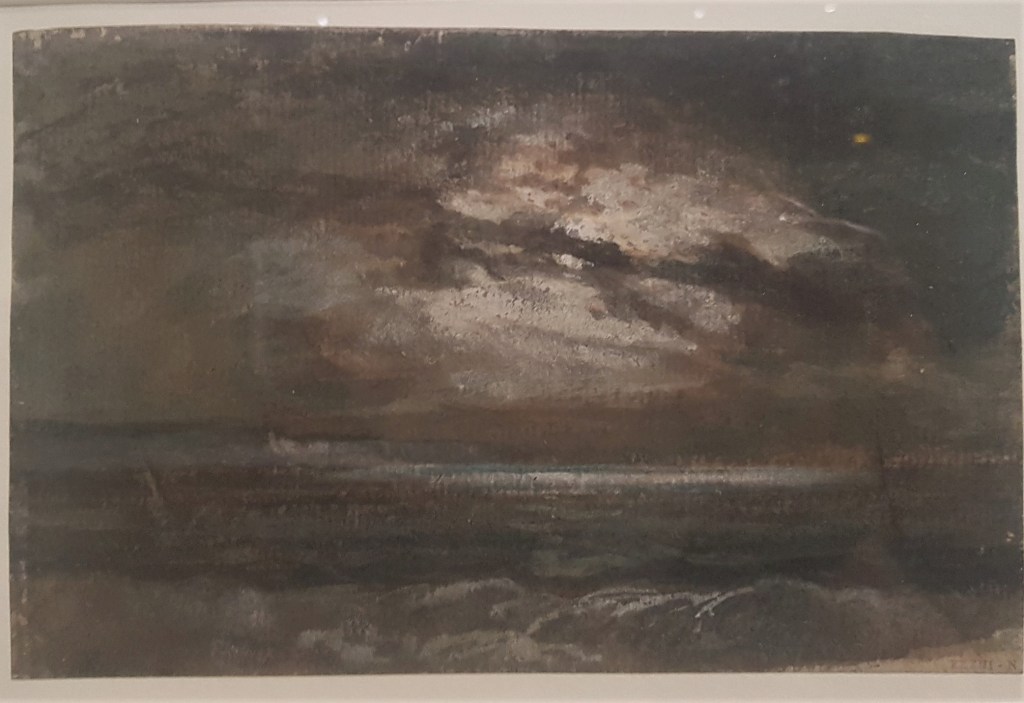
Turner had affirmed that “The Sun is God” and he is aware that sunlight can be depicted in countless ways. Moonlight also intrigues him and gives him the opportunity to employ the colour black in dramatic views of nature. At the same time, he is liberating black from the tradition of the chiaroscuro.

After a first trip to Switzerland and France, where he had the opportunity to study the old Masters in the Louvre Museum, Turner continued to explore landscape in England. Bridges provided the short-cut between foreground and background; the perspective opens up and more layers are exposed to the sunlight. This is a typical organization scheme of Turner’s, with the action concentrated on the bridge.
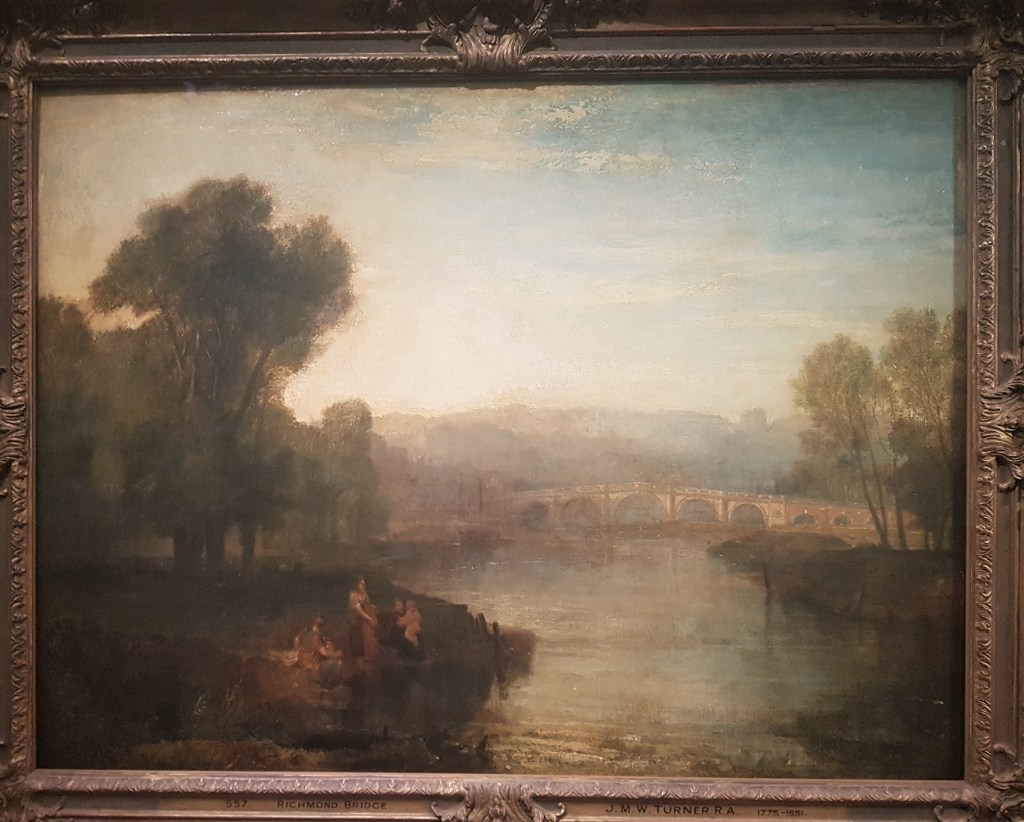
Claude Lorrain was an important influence, whose works Turner appreciated in the Louvre Museum, and whose classicism was a reference. In this view of the Richmond Hill, the contrast is striking between the mist in the back and the shadows in the front, exhibiting his skill to translate a sketch to an accomplished work with the magnificence of sunlight as the protagonist. The bridge plays again the role of a focal point.
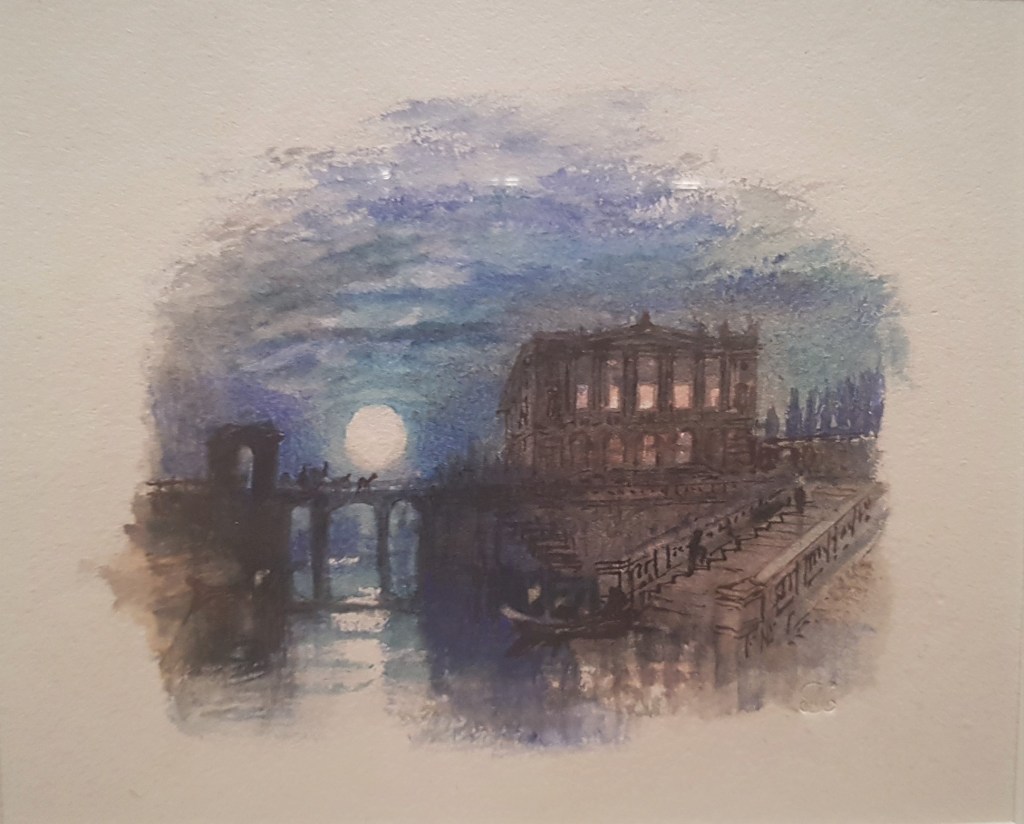
Nightlight is also the subject matter of this drawing of a villa, for the illustrations of a book on Italy by Samuel Rogers. Turner follows the text but he has the experience and the eye to create a night view, hailed by the critiques at the time, especially regarding the highlights in ink that accentuate the perspective and the effects of light.
By the 1830s, Turner had visited most of the famous attractions in Europe, especially mountains and rivers. Italy was the absolute stop of the “Grand Tour” and a source for all artists seeking inspiration and confirmation.

At his first visit to Venice, Turner found a special atmosphere to translate in colour. Having already reached a liberty in his sketches, he created views like never before. The public, being used to the vedute, post-card-like paintings of the city, was confronted to just the vaporous light and the transparency, resuming the atmosphere of the city that seems to float on the water surface.
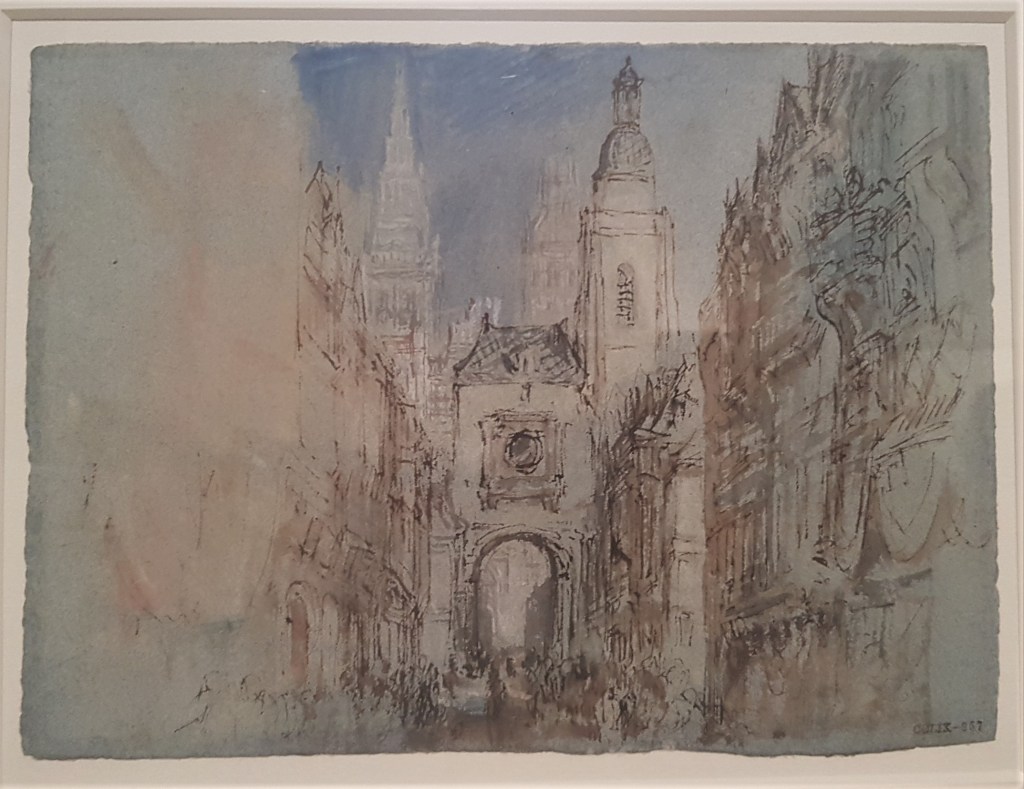
In France, Turner made over 3000 sketches and drawings of its rivers, landscapes, and towns. These sheets were very rarely turned into accomplished works. The River Seine naturally attracted him, like the artists who followed next and painted the effects of light on its riversides: the Impressionists. Rouen appears blurry and precise at the same time, due to his capacity in combining different brushstrokes to render multiple aspects.
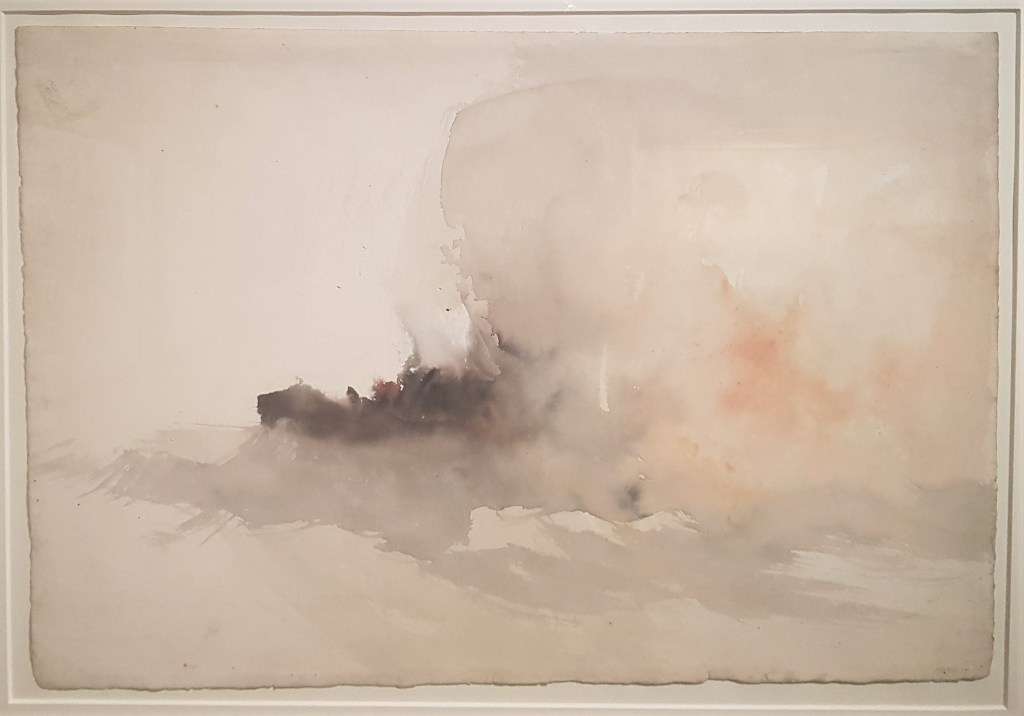
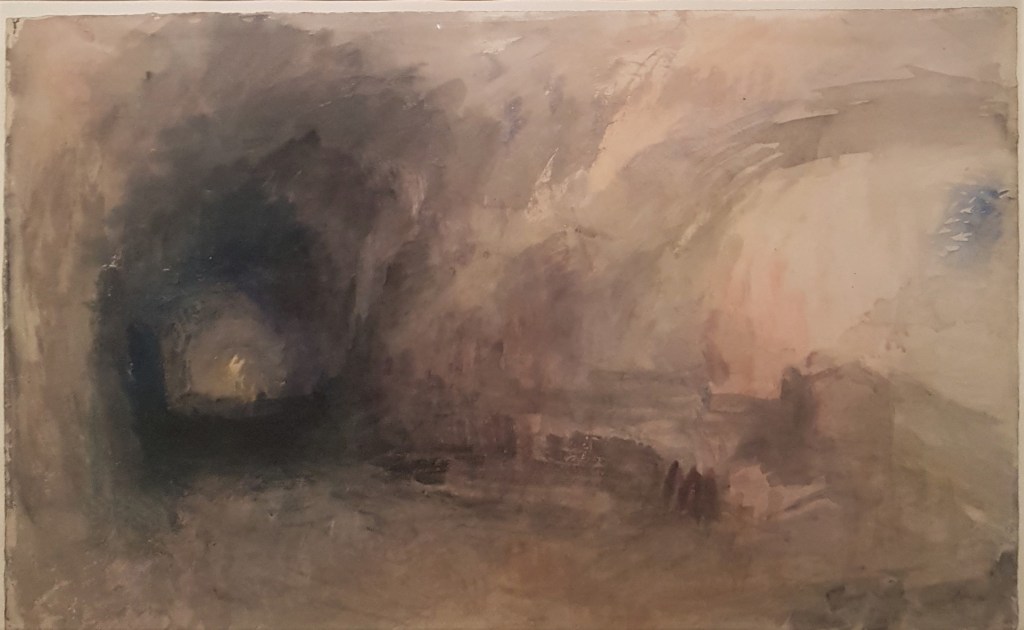
In the two watercolours above, his mastery and self-confidence are obvious. The Ship Wreck, under the influence of the natural and light effects, is the pretext to examine and depict their synergy that contributes to the dramatic dimension. The drawing seems simple, even abstract and yet it conveys all the force of nature and the powerlessness of man. In the Mountain Pass, the spectator is overtaken by the force and the size of the natural elements.

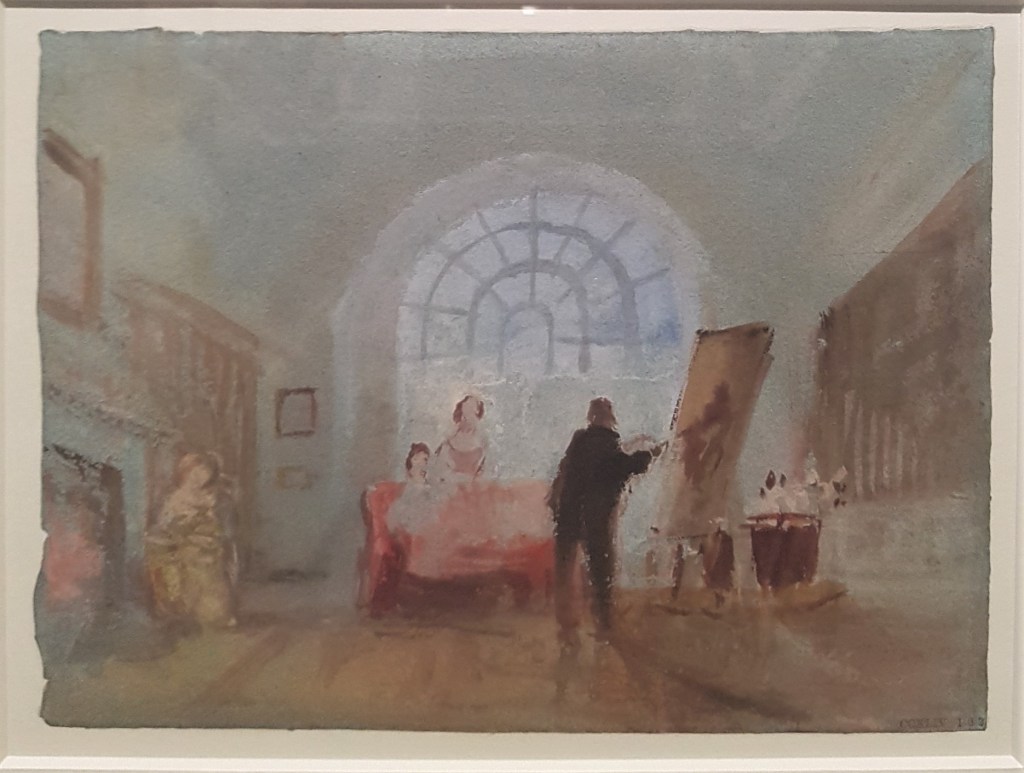
Interior views have also been depicted by Turner. During his trips, he would stay with friends whose mansions and lands would become an exciting theme. In Sussex, as the guest of Lord Egremont, his patron, Turner continued exploring the interaction of various surfaces and details with light.
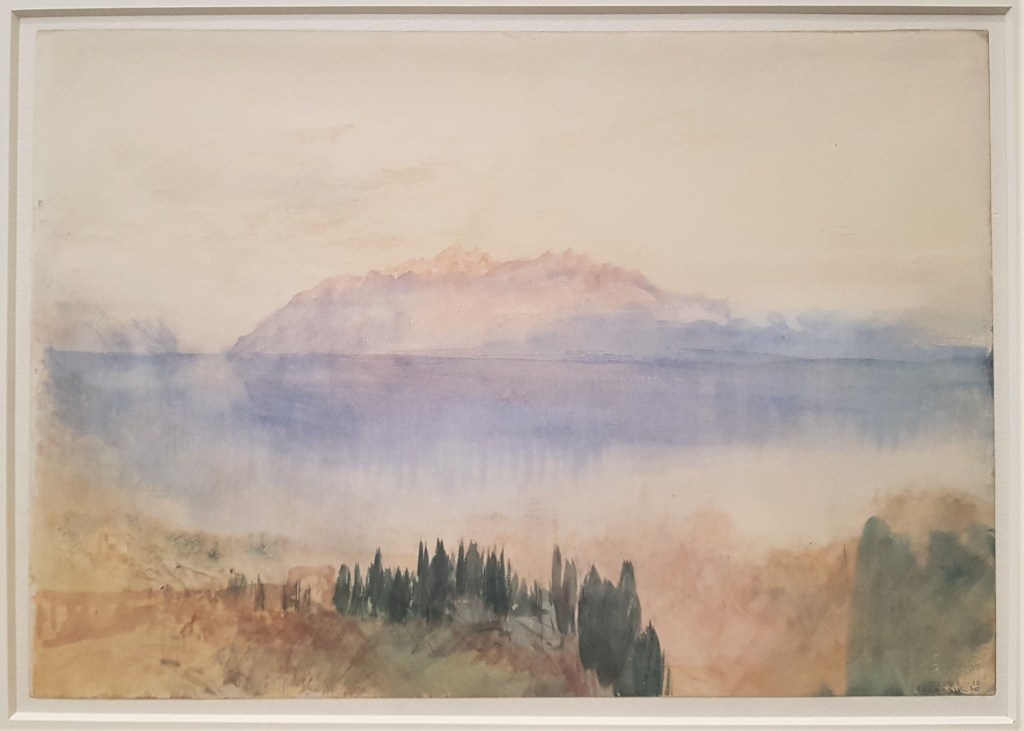
A relentless traveler, never staying in the same place for too long, he had visited and recorded in his sheets, landscapes in France, Italy, Germany, Holland, Belgium and Switzerland. This view of the Lake Geneva captures the haze of the moment and the finesse of the reflection on the water. Aware of his reputation and his legacy, Turner considered watercolours as a full demonstration of his achievements and began organizing and displaying them by the 1840s, like any other fine art.
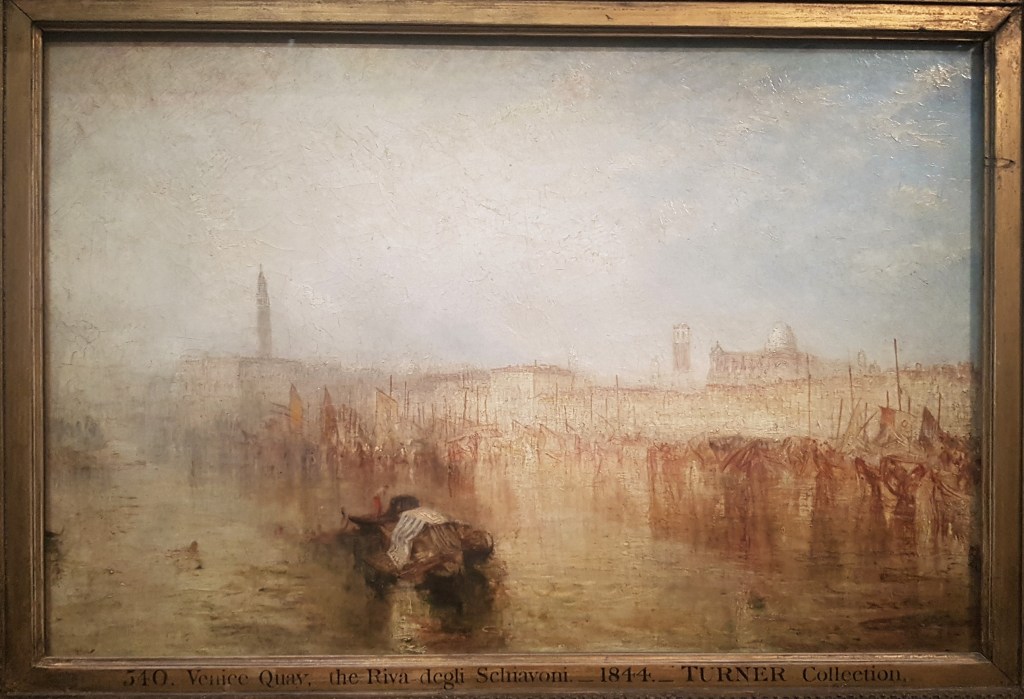
The exhibition ends with some of his last paintings: the synthesis of all his observations and conclusions. Turner travelled to Italy on three occasions. Venice always provided the scenery for multiple renderings of the sunlight. The view was famous even back then, Canaletto and Guardi being its undisputed masters, but Turner offers a different visual and mental angle, erasing the distance between us and the subject matter. Slightly off-balance, the landmarks are all here, but fused together to create the unique experience of the Serenissima, in shades of yellow, the colour affectioned by Turner. The colour yellow is used extensively in his skies, while progress in chemistry allowed new hues to be commercialized, allowing him to obtain luminosity and make his technique evolve.
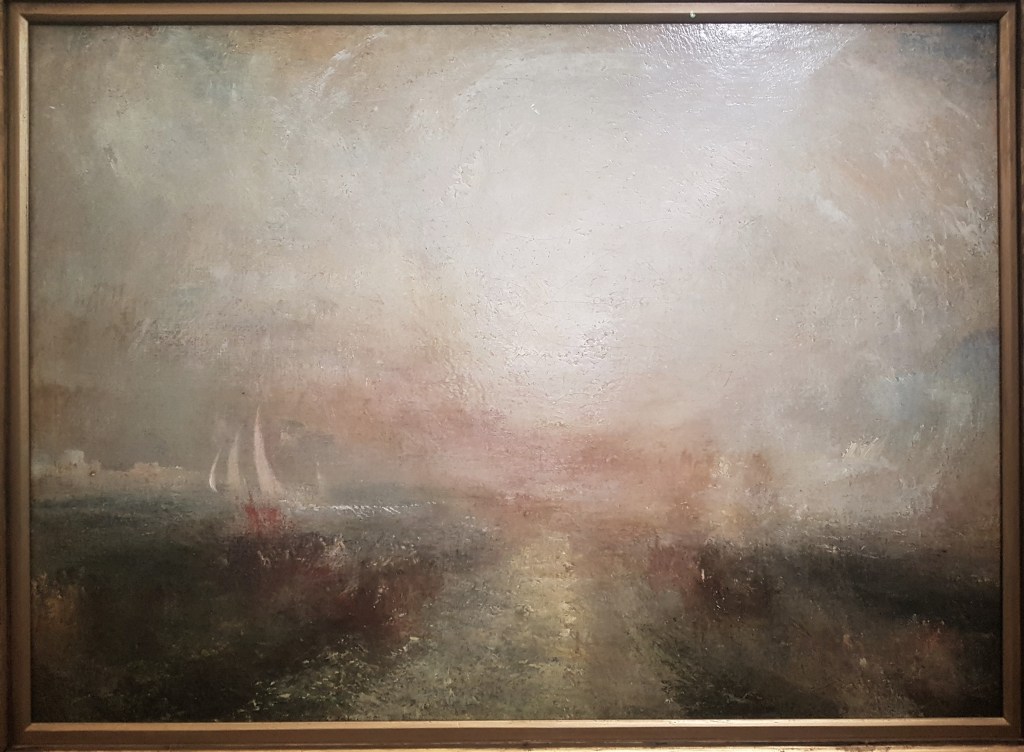
Having followed his travels across the Continent, translated to colour and light, a conclusion is perfectly given by the Yacht Approaching the Coast. The dark sea and the blinding light create a dramatic contrast; the sails, depicted with only a few brushstrokes translate the struggles in the dangerous waters under the tormented sky. Turner is not just the observer, but a visionary of the artistic expression yet to come, beyond a fixed subject matter.
Turner masterfully succeeded in transmitting the flexibility of oil-painting to watercolours in order to conserve its luminous aspect. The last paintings are the obvious masterpieces. After his death, in 1851, watercolour become progressively a minor art, very probably because any great artist could not compete with Turner.
Turner: Paintings and Watercolours, Tate’s Collection, Musée Jacquemart-André, Paris, until January 11, 2021
All images (c) TheChoiceOfParis
 The Choice of Paris